Welcome
Welcome to the Quantification Analytics Tool (QAT) Documentation Site!
- For end-users, see the User Manual.
- For technical administrators, see the Developer and API sections. To learn more about QAT, please read on below.
What is QAT?
QAT is a modernized solution for country-led forecasting and supply planning. QAT has a forecasting module and a supply planning module, and can be used for any health commodity.
- Forecasting: An estimate or prediction of the quantities of products to be consumed by clients or consumers over a future period.
- Supply Planning: The component of supply chain management focused on fulfilling demand plan requirements. The goal is to balance supply and demand to meet the financial and service delivery objectives of the health program.
Key Features:
- Web-Based with Offline Capabilities: Seamless data sharing across stakeholders and public health systems, plus reliable data entry and management without a constant network connection.
- Scalable: Built on a modern, operating-system-agnostic architecture - all you need is a web browser.
- User-Centric: Focused on usability and automation to drive end-to-end data visibility and evidence-based decision-making. Availalbe in mulitple languages.
- Standardized: Master data management to drive consistency across all programs.
- Better Together: Forecasting & Supply Planning in one tool, with seamless integration between the two modules.
- Visually Rich: Charts and tables to help stakeholders better understand their data and make decisions.
- Flexible Forecasting:
- Customizable tree structures (demographic, morbidity, services) to allow forecasts based on multiple types of data.
- Advanced extrapolation methodologies, including moving averages, semi averages, linear regression, Holt-Winters, and Auto Regressive Integrated Moving Averages (ARIMA).
- Forecasting tree development that allows flexibility for multiple applications.
- Visual comparison of multiple forecast outputs to drive stakeholder consensus and selection of final output.
- Advanced Supply Planning
- With forward-looking tracking of stock balances, scenario planning, batch/expiry tracking
- Monitoring stock balances, in terms of quantities and months of stocks on hand in the entire program, visually identifying identifying overstocks, understocks and stock outs
- Calculation of estimated shipment and freight costs and estimated budget expenditures.
- Comparison of alternative procurement scenarios and analysis.
- In-tool supply plan review, flagging procurement planning not matching lead time settings, missing data, or stock riss.
Who Should Use QAT?
QAT is useful to supply planners, forecasters, Ministry of Health staff, procurers, donors and other stakeholders, both in country and at the global level. Below is how you might use QAT to help quantification in country:
| Forecasting | Supply Planning |
|---|---|
QAT allows you to forecast using different methodologies (consumption, demographic, morbidity, services).
| QAT can be used to bring together procurements (from all funders and procurement agents), forecast consumption and inventory data to calculate future shipment quantities and timing, project future expiries, inventory, and stock status.
|
History of QAT
QAT was built with funding from the U. S. Government under the Global Health Supply Chain – Procurement and Supply Management (GHSC-PSM) program.
| Month | Milestone |
|---|---|
| Jan 2020 | QAT development began under GHSC-PSM, building on functionality of legacy tools like PipeLine & Quantimed |
| Nov 2020 | Due to COVID-19, first countries trained on QAT supply planning module remotely |
| Dec 2020 | QAT Supply Planning Module Live |
| June 2022 | QAT Forecasting Module Live |
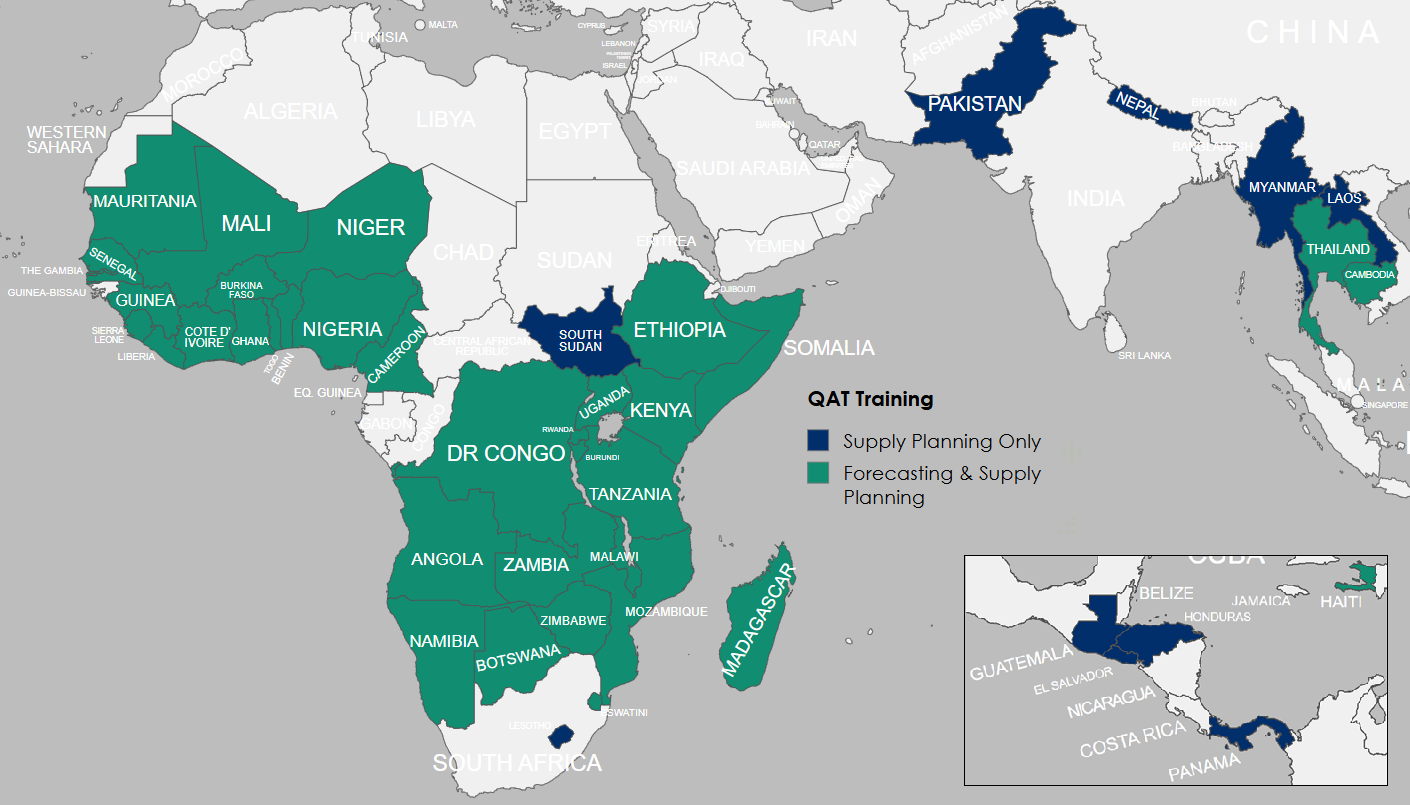
| 2021-2026 (present) | 44 countries trained in QAT supply planning and forecasting modules. |
Which countries have been trained on QAT?